

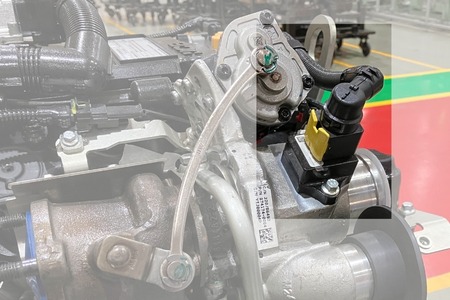
Why the need for precise mass air flow measurement on the engine? Stricter emission standards, such as Euro 6 and 7, China 6 and 7, and Bharat 7, combined with ever-decreasing installation space, present a challenge. Engine developers of trucks, construction machinery, and agricultural machinery are familiar with this dilemma. Measuring devices on commercial vehicle engines must be precise, robust, and durable, withstanding up to 1.6 million kilometers. This article describes the locations for mass air flow measurement on the engine, environmental influences affecting accuracy, and common errors occurring during installation and operation.
Why mass air flow measurement on the engine is one of the most demanding measurement tasks
A commercial vehicle engine is not a laboratory environment. It vibrates, pulsates, and experiences temperature extremes for years on end. Precise measurements can only be obtained if the measuring principle, measuring location, and installation situation are perfectly matched. Accurate air and exhaust gas recirculation measurement — EGR measurement, for short — is the basis for complying with emission limits.

The differential pressure principle: robust, low-maintenance, and pulsation-resistant
Differential pressure measurement, or dp measurement, is proven for use on engines. A primary element in the flow path, such as a Venturi tube or a pitot tube, generates a pressure difference, proportional to the flow velocity. The sensor and evaluation electronics use this to calculate the mass flow. Since the primary element has no moving parts, the measuring principle is particularly robust against vibrations and contamination. This enables accurate mass air flow measurement over a long period of time. DP systems with sampling rates of over 2 kHz can calculate engine-related pulsations in real time.
Venturi: A nozzle with smoothly tapered inlets and outlets
dp: Differential Pressure
EGR: Exhaust Gas Recirculation
Pitot tube: a measuring device located directly in the gas flow
Inlet sections and installation space
The underestimated basis for precise mass air flow measurement on the engine
What is an inlet section, and what happens if it is too short?
The inlet section is the straight, undisturbed pipe section upstream of a measuring device where the
flow calms down. Gas that has just passed through a bend, a valve, or a turbocharger flows chaotically and asymmetrically. This leads to incorrect measurements. In the confined engine compartment, achieving
the ideal inlet section is often difficult. Flow straighteners and CFD simulations are used to optimize installation locations on a computer during the development phase.
Flow straighteners: grid-like pipe inserts that mechanically straighten the profile
CFD simulation: Computational fluid dynamics — numerical flow simulation
Locations for mass air flow measurement on the engine
Advantages and disadvantages at a glance
Several typical positions exist for mass air flow measurement on commercial engines, each with its own pros and cons.
Measuring locations in detail
1. Before the turbocharger: smooth flow and varied piping
On the intake side before the turbocharger, temperatures and pressures are moderate, and the flow is relatively smooth. However, the piping varies greatly depending on the vehicle and engine variant, making calibrating the measuring device more complex. This measurement location is particularly suitable if there is little variation in the air ducting.
2. and 3. Before and after the intercooler: Less pulsations vs. direct installation advantage
The intercooler, a heat exchanger that cools compressed air heated by the turbocharger, has a useful side effect: it dampens pulsations. This means that very accurate measurements are possible before the intercooler, even though at high temperatures. After the intercooler, low temperatures often allow for direct flange installation without additional brackets. While this saves installation space, the pulsations are particularly strong here, making signal processing more difficult.

4 and 5: Hot and cold exhaust gas recirculation (EGR): Conflict of objectives between pressure loss and EGR rate
In the EGR line, exhaust gas flows back into the intake tract to reduce nitrogen oxide (NOx) emissions. This is one of the most challenging environments for measurement technology because soot particles, oil mist, and condensates are deposited on the primary element in the cold EGR after the EGR cooler. Additionally, many measuring devices generate pressure loss in the EGR channel. That leads to reduced EGR rates and undermines the emission concept. Modern coatings on the primary element counteract this problem by reducing particle deposits and making the measuring element more resistant to aggressive exhaust gas components.
6. Exhaust System: Extreme temperatures and the strategic role of the particulate filter
Extreme conditions prevail in the exhaust system, such as those involved in controlling AdBlue injection at the SCR catalytic converter. Taking measurements after the diesel particulate filter makes sense here: The exhaust gas is largely free of particles, which greatly reduces deposits on the primary element. However, the high temperatures require temperature-resistant materials and sensors.
7. Special measuring locations: Natural gas, biogas, and fuel cells
Additional measuring locations arise in natural gas and biogas engines, as well as in multi-stage charging. For fuel cell drives, precise mass air flow measurement is essential for the efficient operation of the fuel stack.
The influence of environmental conditions on measurement accuracy
The underestimated disturbance variables
Pulsations and vibrations: pressure fluctuations as a constant challenge measurement under variable engine conditions
Pulsations caused by valve operation and the engine’s mechanical vibrations make precise mass air flow measurement on the engine difficult. These vibrations are particularly strong after the intercooler. The engine valves generate rhythmic pressure surges in the intake pipe, by opening and closing. DP flow measurement systems with pitot probes operate without moving parts. This makes them significantly more robust than devices based on other measuring principles when it comes to such influences. The evaluation electronics are also crucial; adaptive filter algorithms with high sampling rates reliably separate pulsations from actual mass flow. This works even at highly pulsating measuring points, such as after the intercooler.

Temperature extremes and density compensation: Why volume flow is not enough
Flow meters initially measure volume flow. However, what engine developers need is the mass air flow, or the weight of the gas per unit of time. Since the density of gases changes significantly with temperature and pressure, continuous density compensation based on current measured values is necessary. This issue is especially apparent in the exhaust system, where temperatures can fluctuate from below 100°C at idle to above 500°C at full load depending on the engine’s load. Therefore, integrated sensors that incorporate both into the mass air flow calculation in real time are not just an option, but a necessity.
Particles, soot, and condensates: Long-term drift due to deposits
Deposits of soot particles, oil mist, and condensates gradually alter the geometry of the primary element and, consequently, the measured value. This long-term drift is dangerous because it builds up slowly and is undetectable during commissioning. It mainly affects measuring points in the EGR line because chemically aggressive exhaust gas components, such as sulfur dioxide, nitrogen oxides, and condensed acids, are present. This requires the use of corrosion-resistant materials and protective coatings. Anti-adhesive coatings and aerodynamically optimized geometries, such as Venturi shapes, minimize the risk of deposits.
Typical sources of error during installation and operation and how to avoid them
Development and installation errors: too short inlet sections and incorrect assembly
Errors can occur at two stages: during development and during assembly. During the development phase, measurement locations are sometimes not planned with sufficient consideration of metrological requirements. For example, a lack of space can result in an inlet section that is too short. These systematic design errors affect all vehicles in a series and are difficult to correct retrospectively. Additionally, assembly errors can occur, such as an incorrectly aligned pitot tube, a flange gasket that protrudes into the cross-section, or leaky pressure hoses, which can distort the measurement on a specific vehicle.
While both types of errors rarely lead to the immediate total failure of the engine or the measuring device, they do distort the measurement. While this may not be noticeable during commissioning, it leads to permanently increased emissions and lower efficiency over the vehicle’s entire service life.
Operational drift: How measuring devices lose accuracy over time
Even correctly installed measuring devices can lose accuracy over time due to deposits on the primary element, corrosion in aggressive media, abrasive particle wear, or seals fatigued by heat, cold, or temperature changes. Therefore, measuring devices, especially those in commercial vehicle engines, must be stable in the long term. This can be achieved through the use of corrosion-resistant materials, suitable coatings, and a sensor architecture with proven zero-point stability. For reference, systec Automotive specifies an accuracy of better than 1 % at commissioning and better than 2 % over the entire vehicle life for its TFI sensor platform.

Conclusion: Precise flow measurement on the engine requires an understanding of the system. And the correct sensor.
Achieving precise mass air flow measurement on the engine involves more than just selecting the appropriate sensor. The measurement location, intake distance, robustness against environmental conditions, and careful installation must all be considered to ensure consistent, precise flow measurements. These factors are essential for efficient engine management that complies with emission standards throughout the vehicle’s whole service life.